


Quick Answer: No, a crooked nose usually isn’t from a broken nose. It’s typically caused by natural cartilage/bone asymmetry or a deviated septum.
If you have ever looked in the mirror and wondered why your nose seems to tilt or bend to one side, you may be surprised to learn that you do not need a history of injury to have a crooked nose. What causes a crooked nose is often something you were simply born with, like the natural shape of your cartilage and bone or a nasal septum that drifted off center as your face developed. A nose can look noticeably off balance without a single break.
I’m Dr. Nicole Schrader, a facial plastic surgeon in New Jersey who is double board-certified in facial plastic surgery and otolaryngology, the field that focuses on the ears, nose, and throat. That dual training matters with a crooked nose, because the same structures that shape how your nose looks also control how well you breathe. In this article I want to explain the common reasons a nose looks crooked, how to tell whether your concern is cosmetic or functional, and the surgical options that can help.
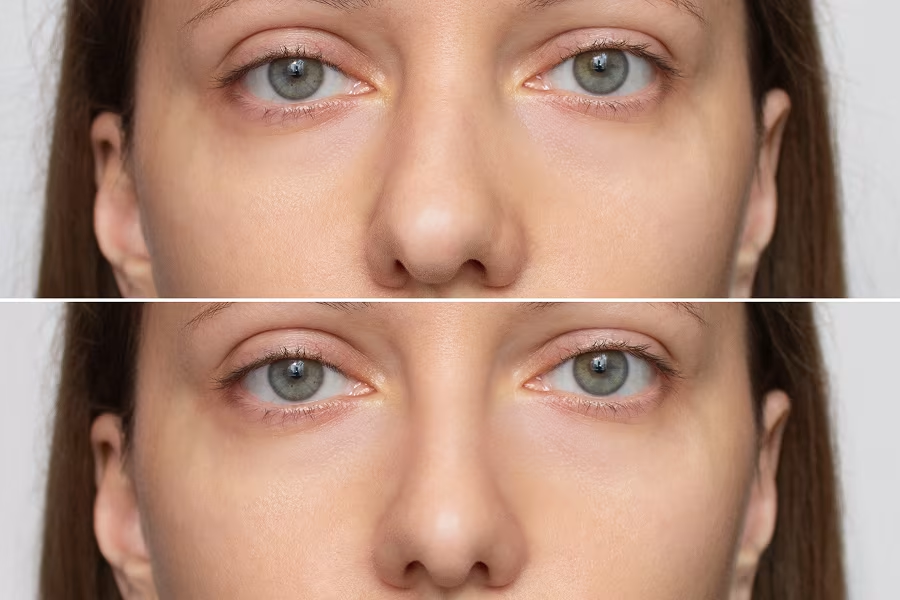
Key Takeaways: What a Crooked Nose Is Really Telling You
- A nose can look crooked even if you have never broken it.
- Natural asymmetry, cartilage shape, and a deviated septum are common reasons.
- A crooked nose can be purely cosmetic, purely functional, or both at once.
- Cosmetic rhinoplasty, septoplasty, and septorhinoplasty each address a different piece of the problem.
- A thorough evaluation is the only way to know which option fits your nose.
Why Your Nose Can Look Crooked Without a Break
A broken nose is only one reason a nose can look crooked, and often it is not the reason at all. Many people come to me convinced they must have injured their nose at some point, when the shape was actually there all along. These are the most common other causes I see.
Natural Facial Asymmetry Can Make the Nose Look Off Center
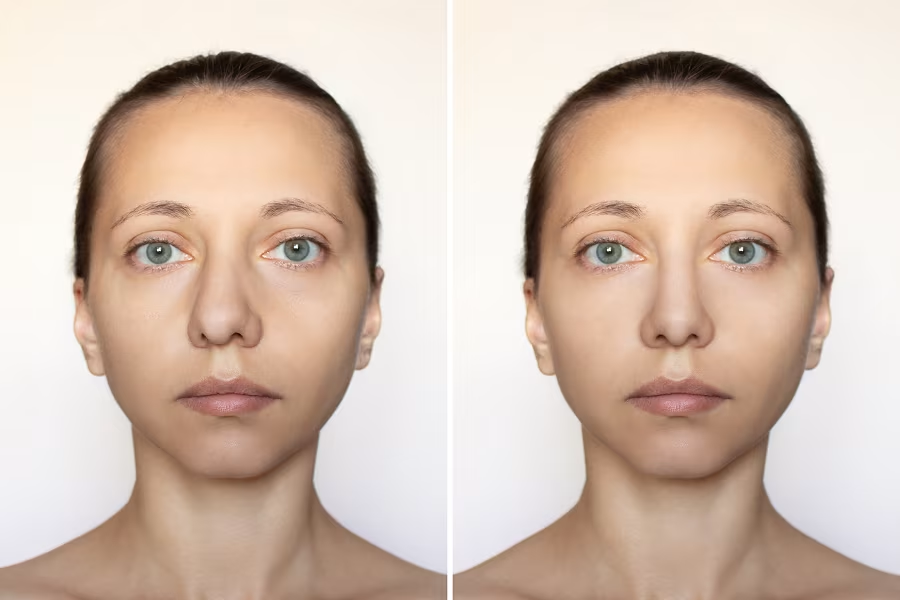
Almost no face is perfectly symmetrical. Your eyes, cheeks, and jaw are all slightly different from one side to the other, and your nose sits right in the middle of that. When the rest of the face is a little uneven, even a straight nose can look off center.
Cartilage Shape Can Pull the Nose Slightly to One Side
Your nose is built from cartilage and bone, and the way those pieces are shaped can pull it gently to one side. This is usually something you are born with rather than something that happens to you. No amount of facial exercises can change it, because the lean comes from the underlying structure, not the muscles.
A Nasal Bridge Can Lean Even Without Past Injury
The bridge of the nose can tilt even when there is no history of trauma. Sometimes this traces back to inherited factors or fetal development, and sometimes it simply becomes more noticeable as the face matures.
Uneven Nostrils Can Change How Straight the Nose Appears
When one nostril is shaped differently than the other, it can throw off how straight the nose looks from the front. Small differences between one nostril and the other are normal, but larger ones can make the whole nose appear tilted.
A Deviated Septum Can Affect Both Shape and Breathing
The nasal septum is the wall of cartilage and bone that divides your nasal cavity into two passages. When it leans to one side, a condition called septal deviation, it can change both the shape of your nose and how easily air moves through it. A deviated septum is one of the most common reasons a crooked nose comes with breathing problems, and it can be present from birth or develop over time.

Trust your face to a specialist
My Goal is to create Harmony, Balance & true Beauty
How to Tell If Your Crooked Nose Is Cosmetic or Functional
Once we understand why a nose looks crooked, the next question is what kind of problem it really is. Some crooked noses are purely about appearance, some cause genuine breathing issues, and many fall somewhere in between.
When the Concern Is Mostly About Facial Balance
If your nose bothers you in photos or the mirror but you breathe comfortably, your concern is most likely cosmetic. In that case the goal is facial balance, making the nose look straighter and more in harmony with the rest of your face.
When Breathing Trouble Points to a Deviated Septum
If you notice ongoing nasal congestion, difficulty breathing through one nostril, or frequent nosebleeds, those symptoms may point to a deviated septum. Some people also deal with chronic sinusitis, frequent sinus infections, facial pressure, or headaches, and a blocked airway can contribute to snoring or even sleep apnea. These are signs that the inside of the nose, not just the outside, needs attention.
Why the Outside and Inside of the Nose Are Often Connected
The shape of your nose and the way you breathe are closely linked. The septum that divides your nasal passages also helps support the external shape of the nose, so one crooked structure can affect both at once. That is why I always look at appearance and breathing together rather than treating them as separate issues.
Rhinoplasty before & after photos
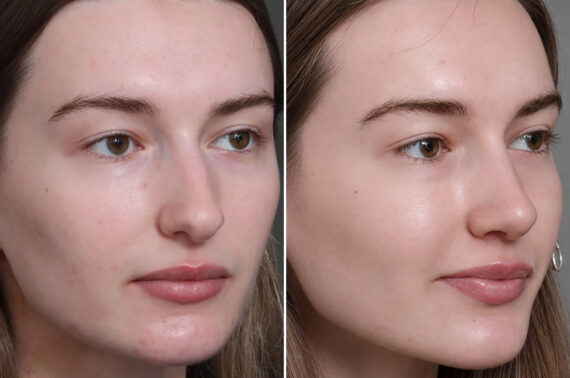
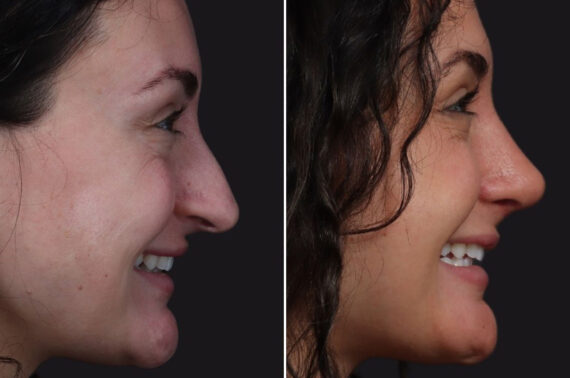
* All patients are unique and individual results may vary.
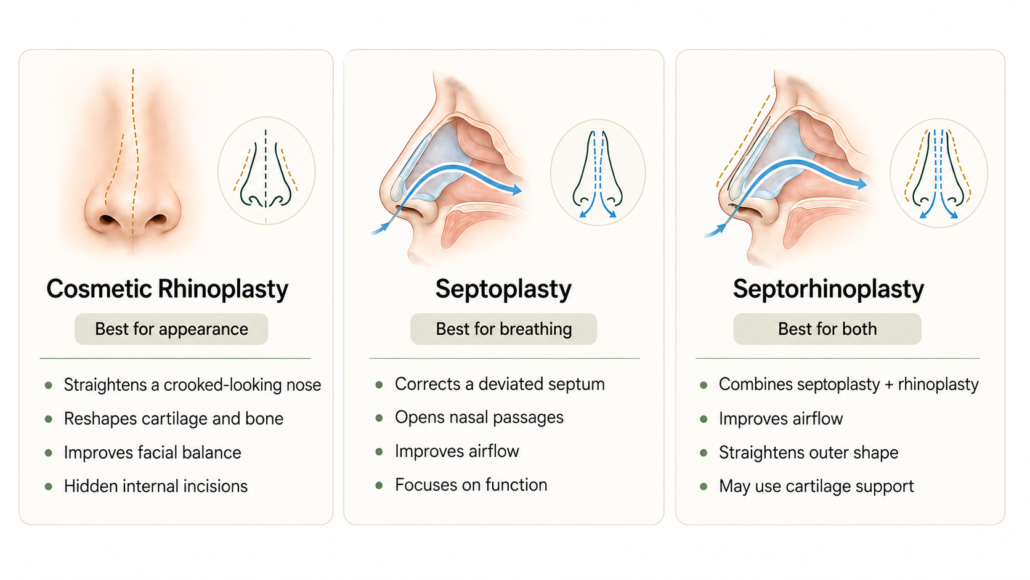
Cosmetic Rhinoplasty for a Crooked Nose
When a crooked nose is purely about appearance, cosmetic rhinoplasty is the procedure that straightens it. This type of rhinoplasty reshapes the cartilage and bone so the nose looks more centered and balanced with the rest of your face. I usually place the incisions inside the nose so there are no visible scars, and I take a conservative approach aimed at a natural result rather than an obviously operated look.
Septoplasty for a Crooked Nose With Breathing Concerns
When the main problem is breathing, septoplasty is the surgery that corrects a deviated septum. During the procedure I straighten and reposition the cartilage and bone of the septum to open up the nasal passages and make airflow easier.
Septoplasty is focused on function, so on its own it is designed to improve breathing rather than dramatically change how the nose looks. For many patients with congestion or frequent sinus infections tied to septal deviation, it can make a real difference in daily comfort.
Because it works inside the nose without reshaping the outside, a septoplasty on its own usually has an easier recovery than a full rhinoplasty, with less bruising and swelling.
Septorhinoplasty for Both Shape and Breathing
Many crooked noses involve both appearance and breathing, and that is where septorhinoplasty comes in. This procedure combines septoplasty and cosmetic rhinoplasty in a single surgery, correcting the deviated septum to improve airflow while reshaping the outside of the nose so it looks straighter.
Septoplasty and septorhinoplasty are both types of functional rhinoplasty, because they improve how the nose works and not only how it looks.
Because I am trained in both facial plastic surgery and otolaryngology, addressing form and function together is something I do regularly. When extra support is needed, I can use cartilage from the septum or the ear to reinforce the structure.
What Dr. Nicole Schrader Looks For During a Crooked Nose Evaluation
A careful evaluation is the foundation of a good result, so I never rush this step. I start by reviewing your health history and asking about breathing problems, past injuries, and symptoms like congestion or nosebleeds. Then I examine the nose from the outside to see how it sits within your face, and I look inside using a nasal speculum to check the septum and the nasal passages.
This combination of an external and internal exam is how I reach an accurate diagnosis of what is causing the crookedness. In many cases I also use 3D imaging so we can look at your nose together and talk through realistic goals before any decision is made.
What to Expect From Crooked Nose Rhinoplasty Results
Healing from nose surgery happens in stages. I usually remove the splint and sutures about a week after surgery, and the bruising and swelling around the nose and eyes settle over the first couple of weeks. Most patients see a noticeably straighter nose within two to three weeks, and the finer details keep refining as residual swelling fades over the following months.
Like any nasal surgery, crooked nose procedures carry some risks, including bleeding, infection, and the small possibility of needing a revision, and I review these complications with you before we proceed. The long-term prognosis is excellent, and results are generally permanent unless a future injury changes the shape. When breathing was part of the problem, the improvement in airflow tends to become clearer as the inside of the nose heals.
Schedule a Crooked Nose Rhinoplasty Consultation With Dr. Nicole Schrader at Schrader Plastic Surgery
If your nose looks crooked and you want to understand why, the best next step is a consultation where we can examine it together and talk through your options. I see patients at our Princeton, Robbinsville, and Voorhees offices in New Jersey.
Call our office or request a consultation online to get started.
ABOUT THE AUTHOR
Nicole Schrader, MD, FACS
Dr. Nicole Schrader is a facial plastic and reconstructive surgeon with advanced specialty training in procedures of the face, head and neck. Her background combines surgical expertise with an in-depth understanding of facial anatomy, aesthetics and reconstructive techniques.
Dr. Schrader’s credentials include:
- Board-Certified in Otolaryngology and Facial Plastic & Reconstructive Surgery
- Residency — Otolaryngology–Head & Neck Surgery, Temple University
- Fellowship Training — Facial Plastic & Reconstructive Surgery
- FACS — Fellow of the American College of Surgeons
- Medical Research — Contributor to peer-reviewed research and professional medical presentations
Expertise Areas:
Facial Plastic Surgery, Rhinoplasty, Facial Rejuvenation, Eyelid Surgery, Facelift Surgery, Neck Rejuvenation, Reconstructive Facial Surgery and Non-Surgical Facial Treatments.